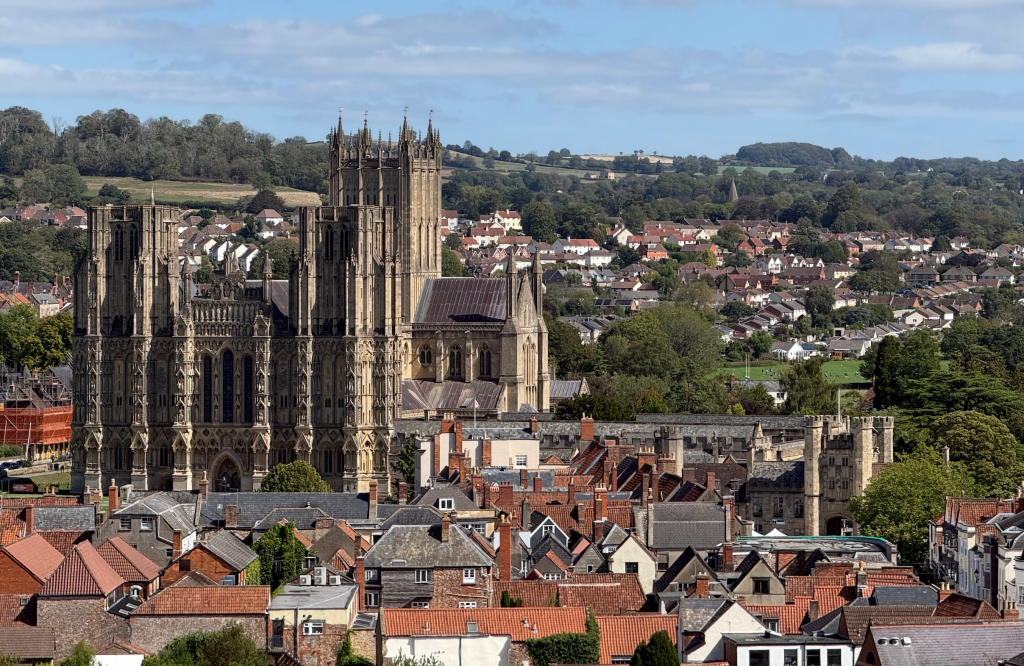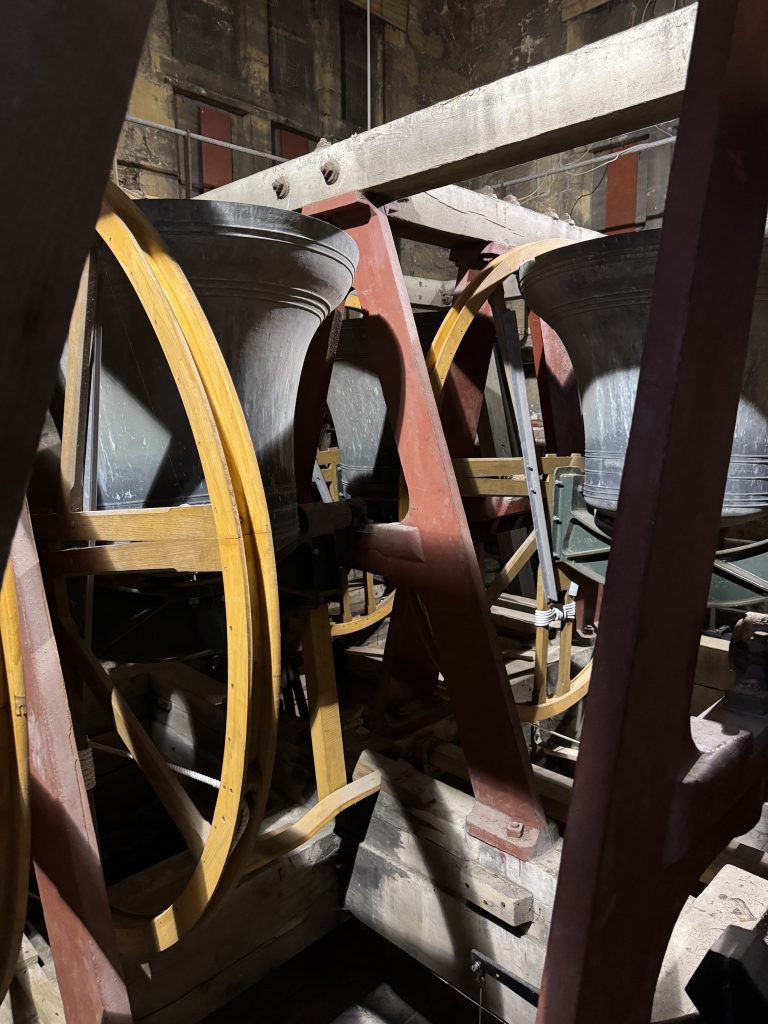
St Cuthbert’s Church is not a museum. It is an exceptional medieval building that has continued to serve the people of Wells for centuries. Its tower, bells and bell ringing are part of that continuing story.
It represents around 800 years of continuous religious and community history. The present church was begun in the 13th century, around the same time as the development of Wells Cathedral, although much of what we see today was substantially remodelled in the 15th Century.
Today St Cuthbert’s Church continues to hold Sunday services for regular worship, accompanied by the ringing of the bells. At Christmas its carol services, crib service and midnight mass encourage less regular church goers to experience the magic of the church. And of course the church is the venue for life events such as baptisms, weddings and funerals – after which the bells are often rung.
The intrepid can head up the tower, via the ringing chamber and belfry, to admire the stunning 360 degree views of the Somerset countryside and the city of Wells from the roof. Tower tours currently take place only on Sunday afternoons in August, but the hope is that the programme can be extended to other times in the future.
St Cuthbert’s on the big screen
Many people will fondly recognise St Cuthbert’s as the church of Sandford in the 2007 film Hot Fuzz. Hot Fuzz, directed by Wells-born Edgar Wright and starring Simon Pegg and Nick Frost, was filmed extensively in Wells. Wright deliberately chose St Cuthbert’s Church as the visual centre of the fictional village of Sandford. Wells Cathedral was digitally removed from wide shots so that St Cuthbert’s would dominate the town.
The churchyard was used for the famous Sandford village fete scene when a piece of masonry from the church tower falls on the unfortunate journalist Tim Messenger. The church and tower are extremely recognisable throughout the scene. Interestingly, the fictional scene has a real-world echo: a lightning strike in 1975 caused a pinnacle at St Cuthbert’s to fall through the nave roof. This has been suggested as a possible inspiration for the film’s tower-related death scene.
2027 is a big Hot Fuzz year, as it will be 20 years since the film’s release. Look out for events around St Cuthbert’s and the city of Wells to commemorate this anniversary.
Whilst St Cuthbert’s continuing religious role in the community is undeniable, the film demonstrates St Cuthbert’s wider cultural significance.
More about the heritage of St Cuthbert’s
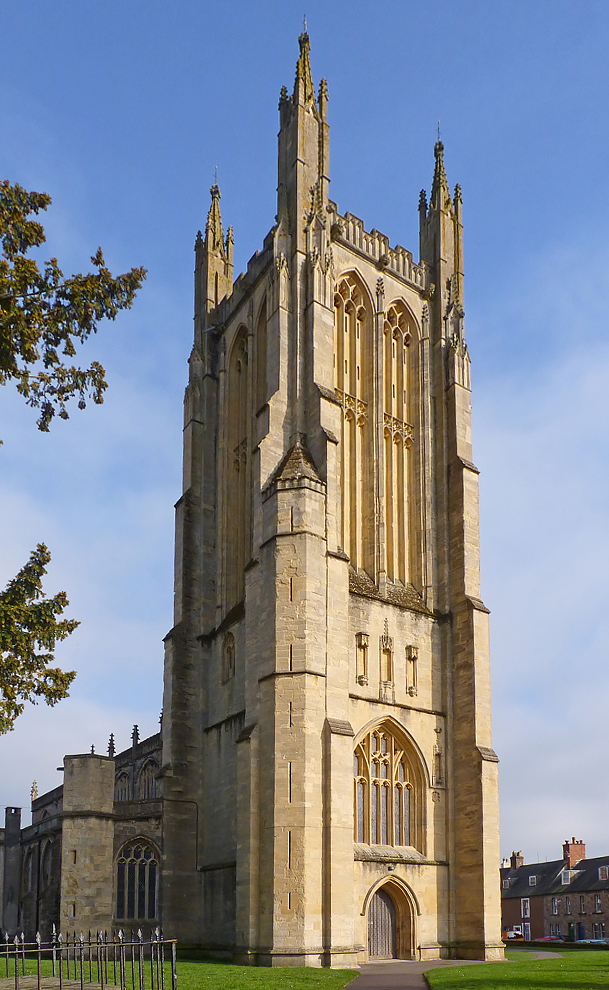
The great west tower is one of St Cuthbert’s defining features and was built to accommodate bells. It is approximately 151 feet (46 metres) high, making it the third-highest church tower in Somerset. It is also one of the reasons that visitors sometimes mistake St Cuthbert’s for Wells Cathedral.
One of the most remarkable features of St Cuthbert’s is its collection of late-medieval painted sculptures/reredos. These were rediscovered during restoration in 1848, and the collection has been described as one of the most important groups of medieval sculpture in an English church today. There is particularly important material associated with the Jesse Tree, dating to around 1470.
The nave has an extraordinary carved and painted angel roof, associated with the 15th/16th-century rebuilding of the church. The National Churches Trust describes the roof as an exceptionally decorated structure containing carved angels, shields and rosettes. It was repainted in 1963, with the colours intended to reflect the original scheme.
There is a link between St Cuthbert’s and the Cathedral’s Chain Library. In the 1640s, when war and Oliver Cromwell threatened the city, St Cuthbert’s became the physical sanctuary for the Cathedral’s Chained Library— keeping those precious, irreplaceable books safe. Today we can still walk into the Cathedral Library and touch the bindings saved by St Cuthbert’s. The very church that saved our written history needs us to save its voice. The bells are history you can hear.
Find out more about St Cuthbert’s Church
DID YOU KNOW THAT THE BEST VIEWS IN WELLS ARE FROM THE TOP OF ST CUTHBERT’S TOWER?