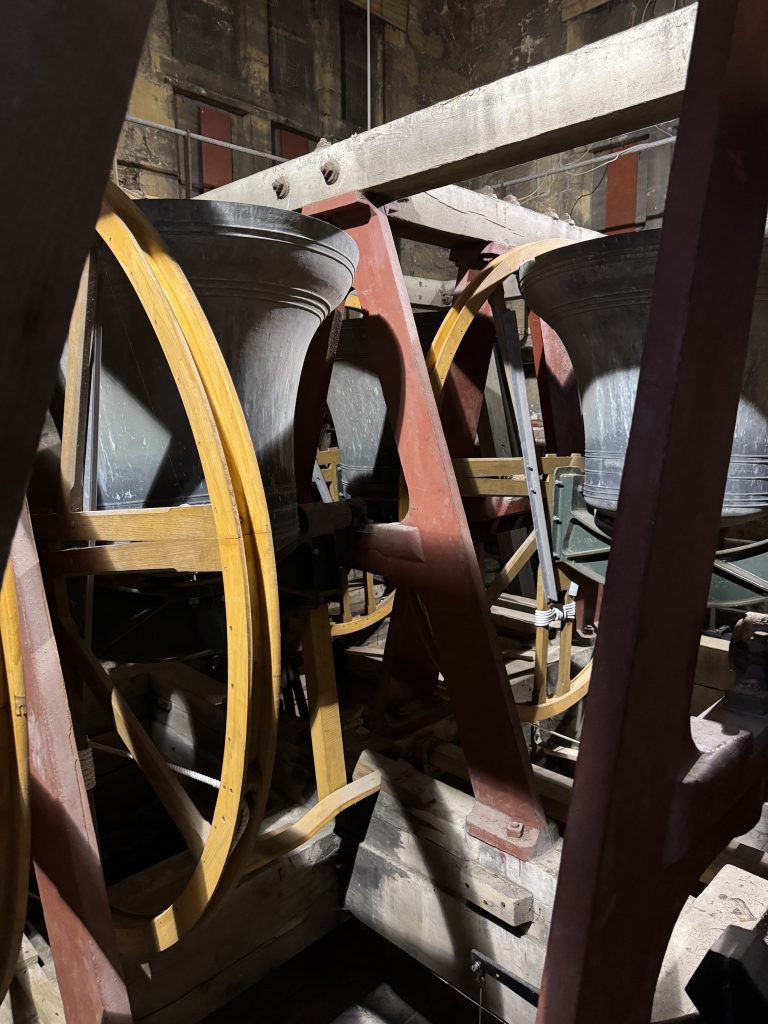
For generations, bell ringing has been part of the life of communities across England. In Wells, it continues to bring people together through a shared combination of music, teamwork, learning and tradition.
For over 150 years the Wells Amateur Bellringing Society (WABS) has supported, promoted and organised ringing at both St Cuthbert’s Church and Wells Cathedral. The numbers of bellringers in the society have ebbed and flowed over the years and we currently have 30 active members, who are joined regularly by bellringers from other towers. This may sound like a healthy number but we sometimes struggle to man all 8 bells on the fourth Sunday of the month, when some of our members ring in the surrounding villages.
We want to encourage new learners, and indeed, several beginners have begun their ringing journey over the last couple of years. However, their job is not easy. It is difficult for new ringers to learn ringing in Wells, because the bells are heavy and difficult to ring. Many potential ringers in the past have been put off and stopped learning. Additionally, within the society, the youngest and oldest members struggle to handle the bells, and even the most practised of ringers can struggle to ring the effectively.
By augmenting, refurbishing and rehanging the bells, the Wells Bells project will create better opportunities for people to learn, practise and participate in bell ringing, helping to make this living heritage more accessible to the community. One of the byproducts of augmenting the bells from 8 to 10 is that the ringing at Wells Cathedral will also improve. The Cathedral has the heaviest set of 10 change ringing bells in the world and we are limited to only one practice night a month on these bells. With St Cuthbert’s also having 10 bells, there will be more opportunities for us practice 10 bell ringing.
Another project aim is to open up bell ringing to the wider community by improving accessibility to what bellringing is and how citizens can become involved. Part of this will see improvements to the safety and accessibility within the belfry so that we can run more tower tours for the community, and particularly for schools. We also plan to install an audio/visual system so that bellringing can be experienced from the floor of the church.

What is Bellringing?
Bellringing, or change ringing, is a unique form of musical teamwork. Rather than playing a melody, ringers work together to produce a constantly changing sequence of notes, with each bell taking its place in the pattern.
Each bell is controlled by one person, but no ringer can ring successfully on their own. The whole group has to listen carefully, respond to one another and work together. This makes bellringing both a musical activity and a practice in concentration, coordination and teamwork. An added bonus is that because bellringing is physical, and often includes a climb up stairs to get to the ringing chamber, ringers benefit from the exercise too.
Change ringing developed in England in the early 17th century, when improvements in the way church bells were hung allowed ringers to control the timing of each bell and deliberately vary the order in which they sounded. Over the following centuries, this developed into the distinctive art and science of English change ringing that continues today.
Learning to ring takes time and practice. New ringers learn alongside more experienced members of the band, developing their skills gradually and becoming part of a supportive community.
DID YOU KNOW THAT THE PHRASE “RING THE CHANGES” WAS ALREADY BEING USED BY 1614?

Find out more about bell ringing in Wells at Wells Bells