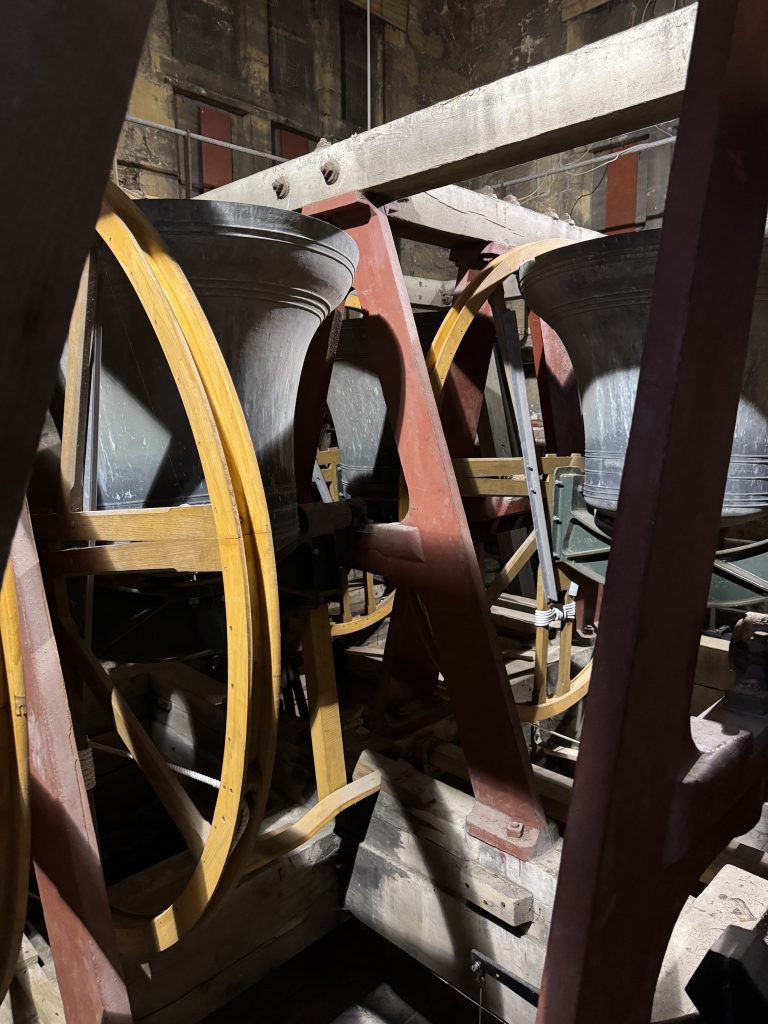
St Cuthbert’s currently has a ring of eight bells hung for full-circle change ringing, with the oldest surviving bell dating to 1683. The bells have a continuing association with the life of Wells and ring out regularly across the city. They are rung for Sunday services, weddings and civic occasions, as well as for practices and more formal ringing.
The bells at St Cuthbert’s are notoriously heavy and difficult to ring with the tenor weighing in at 27cwt or 1.385 tonnes. It is important for the continuity of ringing into the future that there are lighter bells for learners and a set of bells that are much easier to ring than is currently the case.
Wells Amateur Bellringing Society (WABS) is looking to:
- increase the number of bells from 8 to 10 by adding two lighter bells
- retune the existing bells
- replace the oldest bell in the ring that cannot be retuned – the 3rd
- rehang the 3rd so that it can be used for chiming
- house the bells all in a completely updated frame, which is much more fit for purpose than the existing one.

More about the bells
The eight bells are not all from one casting. They are the product of successive generations of the community investing in, maintaining and renewing its bell ringing tradition. The present ring brings together bells cast in 1683, 1785, 1787, 1887–88 and 1992, continuing a tradition of change ringing that has evolved over more than three centuries.
| Bell | Weight | Note | Diameter | Date | Founder |
|---|---|---|---|---|---|
| 1 – Treble | 338 Kg | D♭ | 31.25” or 0.79 m | 1887 | John Taylor & Co |
| 2 | 356 Kg | C | 32.25” or 0.82 m | 1887 | John Taylor & Co |
| 3 | 635 Kg | B♭ | 37.75” or 0.96 m | 1683 | Thomas Purdue |
| 4 | 621 Kg | A♭ | 40.50” or 1.03 m | 1887 | John Taylor & Co |
| 5 | 750 Kg | G♭ | 43.00” or 1.09 m | 1992 | Eijsbouts |
| 6 | 876 Kg | F | 46.50” or 1.18 m | 1785 | William Bilbie |
| 7 | 1131 Kg | E♭ | 50.25” or 1.28 m | 1888 | John Taylor & Co |
| 8 -Tenor | 1385 Kg | D♭ | 55.50” or 1.41 m | 1787 | William Bilbie |
The bells form a descending scale:
D♭ – C – B♭ – A♭ – G♭ – F – E♭ – D♭
from treble to tenor. The tenor therefore gives the ring its fundamental D♭.
How bells are made
Today’s bells are cast by pouring molten bell bronze into a precise two-part mould by the bell founders. Bell bronze is an alloy of roughly 78% copper and 22% tin. Once the bell has been broken out of the mould a master tuner spins the bell on a specialised vertical lathe, shaving microscopic amounts of metal from the interior to adjust its harmonic partial tones until it rings at the exact desired musical pitch.
According to the Heritage Crafts website bell founding is a critically endangered skill.

Our oldest bell was cast in 1683. A 17th century bell would have been cast mouth-down in a deep pit using a multi-layered clay and loam around a rotating spindle, this was then filled with the hot bronze alloy. By the 17th century, bell founding had largely shifted from temporary, on-site pits at churchyards to semi-permanent town foundries, though the core techniques remained rooted in centuries-old traditions.
DID YOU KNOW THAT THE TENOR AT ST CUTHBERT’S IS THE SAME WEIGHT AS A TOYOTA COROLLA HYBRID SUV?